A Real Aquarium Containing A Living Simulated Sea
A hybrid physical + digital installation
2026
A living ocean ecosystem you can study through glass, part aquarium and part simulation
Project Overview:
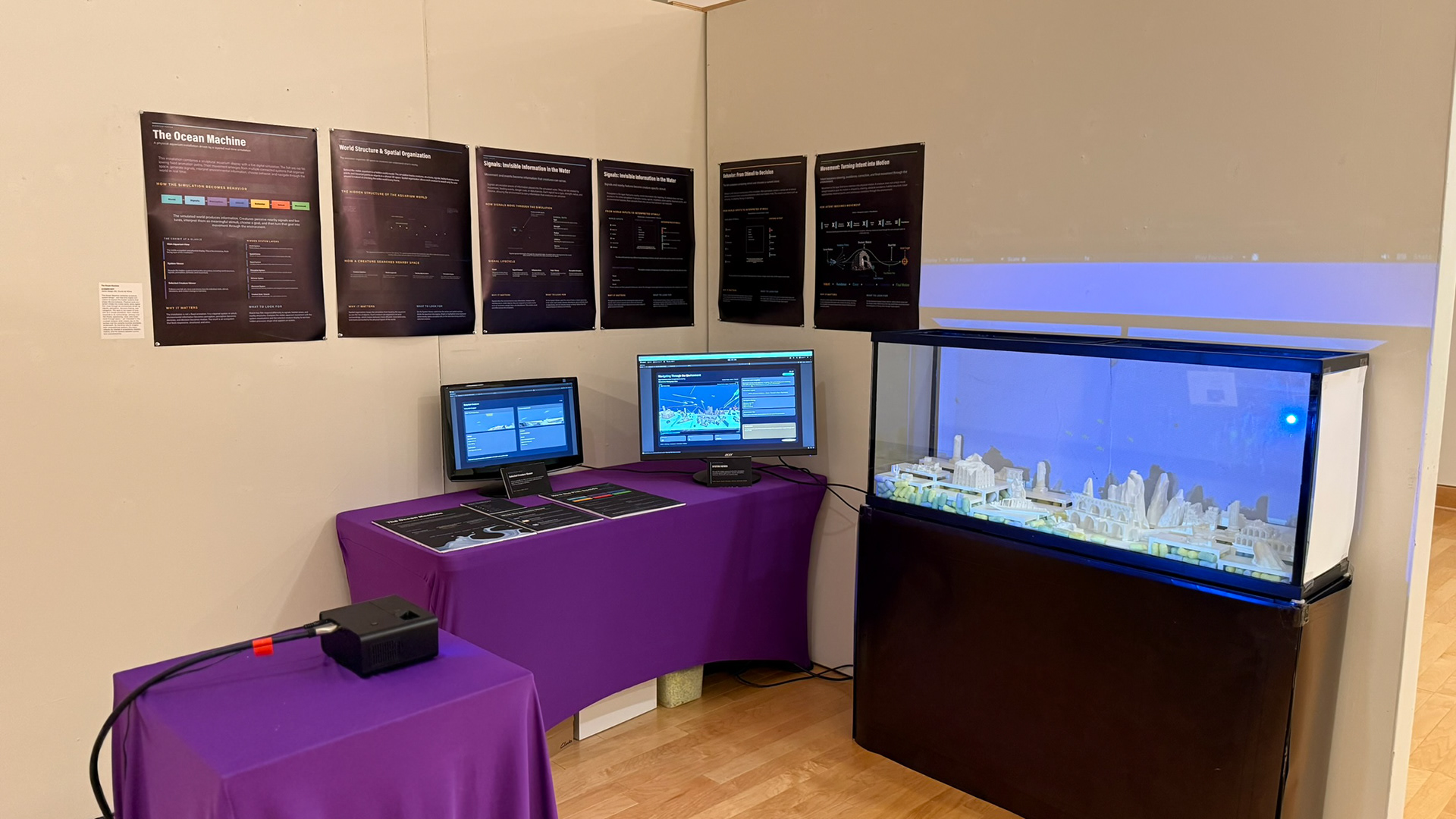
The Ocean Machine is a hybrid physical and digital installation that combines a real aquarium tank, 3D-printed and hand-painted ruins, Unity simulation, projection/screens, and secondary system displays. The project explores how game design systems can make a world feel alive, and how observation and containment shape the way we relate to nature.
Originally developed as my capstone project, the installation was built around three custom system pillars: a three-dimensional octree spatial system, sensing and environmental life systems, and artificial behavior and interaction systems. Together, these systems allowed the simulated world to feel observable, responsive, and alive.
These systems are intentionally designed to be modular and scalable, meaning they can grow into larger simulations and more complex interactive experiences beyond this installation.
Explore The Project:
View the completed installation, documentation photos, artist statement, systems summary, and reflection
Read the original project concept, goals, visitor experience, and exhibition proposal.
Follow the process through planning, system diagrams, tests, fabrication, and installation updates.
The original proposal and devblog remain available as an archive of how the project developed from concept to installed work.
---------
Three-Dimensional Spatial System:
At the foundation of the simulation is a custom built three-dimensional spatial partitioning octree system that organizes everything in the world into an efficient, searchable structure. Instead of treating the ocean as one continuous space, the octree divides it into nested volumes so the simulation can quickly answer questions like what is nearby, what region an entity belongs to, and what objects or environmental signals should be processed at any given moment. This system supports fast spatial querying, scalable world updates, and efficient management of large numbers of entities and data points. It functions as the structural backbone of the project, and it is designed to scale upward as the ecosystem becomes more complex.
Sensing + Environmental Life Systems:
The second core pillar is a set of comprehensive and realistic sensing and environmental life systems, grounded in real ecological computation and data. These systems drive how the world "communicates" internally and externally. This system allows creatures to detect meaningful signals from their individual surroundings, and the environment produces real inputs that can be measured, compared, and interpreted. Rather than relying on scripted triggers, this layer focuses on computed factors such as spatial proximity, vibrational disturbances in the water, and environmental factors that can change over time. This is what ultimately gives the installation its sense of realism, because responses emerge from conditions in the world itself, not from pre-authored events.
Artificial Behavior + Interaction Systems:
The third pillar is my custom built artificial behavior and interaction systems, which take the information produced by the sensing and environmental layers and turn it into believable decision making. Creatures are not simply animated objects. They evaluate what they detect, what they need, what they feel, and choose priorities and carry out responses over time based on internal rules and an everchanging context. This layer is also where interaction becomes visible, as entities influence one another and the ecosystem shifts dynamically as conditions change. Because the behavior and interaction systems are modular, they can be extended into richer patterns, more species-level variation, and larger, more complex ecosystem dynamics as the project grows.